One-tap games give you a single input and grade you on when you used it. That grading window is far narrower than it feels, and most misses are not reaction failures — they are systematic lateness caused by a chain of delays you can measure and partly remove.
The frame is the unit
Browser games render on animation frames. At 60 Hz, a frame is 16.67 ms. At 120 Hz, 8.33 ms. Collision checks, hit detection, and “perfect” grading all happen on frame boundaries, which means every timing window in the game is an integer number of frames.
Typical grading windows in this genre:
| Grade | Frames at 60 Hz | Milliseconds |
|---|---|---|
| Perfect | 2–4 | 33–67 ms |
| Good | 6–10 | 100–167 ms |
| Late/early miss | outside | — |
A 50 ms perfect window is roughly a fifth of a typical human reaction time. That sounds impossible until you realise you are not reacting in these games — you are predicting. The obstacle is visible long before the window opens. Your job is to start the motion early enough that the press lands inside it.
Where your delay comes from
From your decision to the game registering the tap, the chain is roughly:
- Your motor delay — the gap between deciding and the finger actually moving, typically 100–150 ms even when you are not reacting to anything.
- Input device delay — a mouse polling at the 125 Hz default adds up to 8 ms; at 1000 Hz, up to 1 ms. Touchscreens vary widely and are generally slower than a wired mouse.
- Browser event dispatch — the event queues and is handled on the next available frame, up to one full frame of delay.
- Render and display — the game draws the result on the following frame, and the display itself adds its own latency.
Add it up and 60–100 ms between “now” and “the game agrees” is normal. That is longer than an entire perfect window. This is why the single most effective adjustment in one-tap games is to aim for the front of the window rather than the centre — your delay will carry you toward the middle on its own.
The games where this shows up
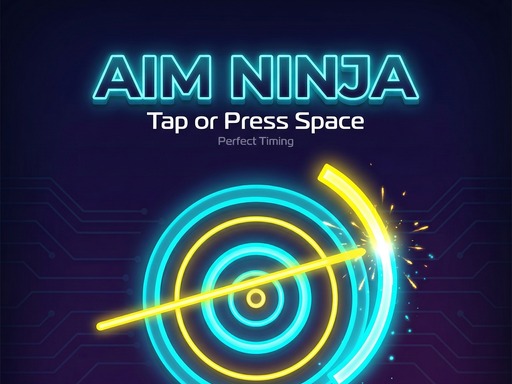
Aim Ninja is the purest test: a needle moves, and you click, tap, or press the spacebar to stop it at the right moment. There is no movement to manage and no route to plan. Every point of score is a measurement of your timing chain. If you consistently overshoot, you are not slow — you are pressing when the needle is at the target instead of when it is approaching it.
Capybara Jump adds a second variable. Wooden blocks slide in from both sides and you time taps to land on them, chaining combos when you land cleanly. Because the blocks are moving, the window is not just “when” but “where” — a press timed to the block’s future position, not its current one. The lead you need scales with block speed, which is why the same timing that worked at the start fails twenty floors up.
Gothic Knife makes the window shrink as a function of difficulty rather than speed alone. You throw knives into a rotating target and must avoid the knives already stuck in it. Each successful throw physically narrows the remaining safe arc, so the window at knife eight is a fraction of the window at knife one, even at constant rotation speed. The correct habit is to slow down as the target fills, not speed up.
Void Orbit inverts the shape entirely: you orbit a central core and tap to reverse direction. The input is not “hit the target,” it is “commit to the other side before the enemy arrives.” Reversal games reward early commitment far more than precision, because a reversal made 100 ms early is usually still safe while one made 30 ms late is fatal.
Practical adjustments that work
- Press earlier than feels right. If you are missing late, shift your entire timing forward by about one frame and re-test over ten attempts. Most players correct by far too much on the first adjustment.
- Use the largest, softest input you have. For a single well-timed press, the spacebar is easier to hit consistently than a small mouse button, because it does not require any aim.
- Fix the frame rate first. Close heavy background tabs. A game that drops from 60 to 45 fps stretches every frame to 22 ms and silently changes every window you have learned.
- Stop after a miss streak. Timing degrades with frustration faster than with fatigue. Three misses in a row is a better stopping signal than any clock.
- Do not chase the combo. Combo pressure makes players press early on the wrong beat. The score from one more combo step is almost never worth the run.
Why this genre is worth practising
One-tap timing transfers. The prediction habit you build in a needle-stopping game is the same one that carries a rhythm platformer, and the early-commitment habit from a reversal game carries straight into endless runners. The whole tap category and the reflex category are built on the same underlying skill with different skins on top.