Idle farm and tycoon games look like they are about growing things. They are actually about a production line with several sequential steps, and like every production line, the whole thing runs at the speed of its slowest step. Players who upgrade the wrong step can spend an entire session improving a number that does not move their income at all.
Break the loop into steps
A farm idler’s loop is usually four steps:
- Grow — a timer runs on the crop or animal.
- Harvest — you click to collect the output.
- Transport — the goods move to a point of sale.
- Sell — the goods convert to currency.
Income per hour is governed by whichever of these takes longest per cycle. Everything else is slack.
Tiny Farm lays the loop out explicitly: click crops to harvest, click the truck to sell and profit, upgrade crops and unlock animals, and collect stars to unlock new farms. Four separate levers, and only one of them is your bottleneck at any moment.
Finding the bottleneck
You do not need to guess. Watch a single full cycle with a timer and note where the waiting happens:
- Waiting for crops to finish while the truck sits empty → grow time is the bottleneck. Upgrade growth speed or add more plots. Upgrading yield per plot here does help, because the constraint is time rather than capacity.
- Crops finished and sitting uncollected → harvest is the bottleneck, and the bottleneck is you. This is the one case where an automation upgrade beats every economic upgrade on the board.
- Goods waiting for the truck → transport is the bottleneck. Truck capacity or speed is the buy; growing more does nothing but deepen the queue.
- Nothing ever waits anywhere → you are balanced, and the correct move is to expand the whole line rather than any single step.
The single most common error in this genre is buying yield upgrades while sitting in case three. More output per harvest, with a transport step that cannot carry it, produces exactly zero additional income and a larger pile.
Yield vs cycle time, in numbers
Say a crop yields 10 units in a 60-second cycle. Income is 10 units per minute.
- Double the yield: 20 units per 60 seconds = 20 per minute.
- Halve the cycle: 10 units per 30 seconds = 20 per minute.
Identical — if every other step keeps up. But they fail differently under load. Doubling yield doubles the amount each downstream step must handle in the same time, which stresses transport and storage. Halving cycle time doubles the frequency of handling, which stresses your attention if harvest is manual.
That asymmetry gives a decent rule of thumb: if the loop is automated, prefer cycle time. If the loop is manual, prefer yield, because fewer, larger harvests cost you less clicking for the same income.
Storage caps are silent bottlenecks
Most farm idlers cap how much can accumulate before production halts. The cap turns your offline time into a hard limit: a barn that holds two hours of production earns nothing from hour three onward, no matter how good your farm is.
Two consequences:
- Check in at the cap, not on a schedule. If storage fills in 90 minutes, a 90-minute rhythm extracts everything and a 4-hour rhythm wastes more than half.
- Storage upgrades are cycle-time upgrades in disguise. They do not raise production; they raise how much production you are allowed to keep. When you are hitting the cap, a storage upgrade is often the highest-value purchase available even though it shows no income number.
When the loop has a body in it
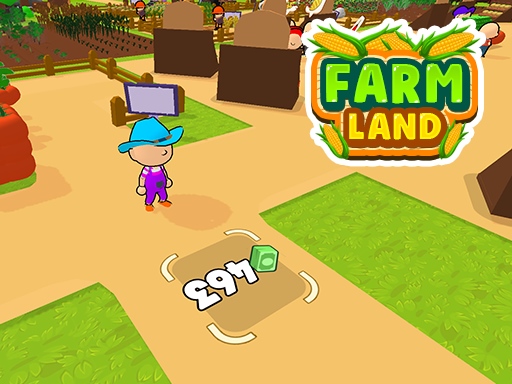
Some farm and tycoon idlers make you physically walk between stations, which adds a movement step to the loop. My Happy Farm uses WASD or arrow keys to move front, back, left and right, with mouse clicks for buttons — and frames the game explicitly around strategy and timing rather than clicking and waiting: invest in farms or crops first, expand the land or upgrade equipment.
Movement time is a real cost and it is usually invisible in the upgrade shop. Two habits recover most of it:
- Route, do not wander. Walk a fixed circuit that touches every station once rather than chasing whichever thing finished most recently.
- Place upgrades by walking distance. When a game lets you choose what to expand, the station you visit most should be the one closest to everything else.
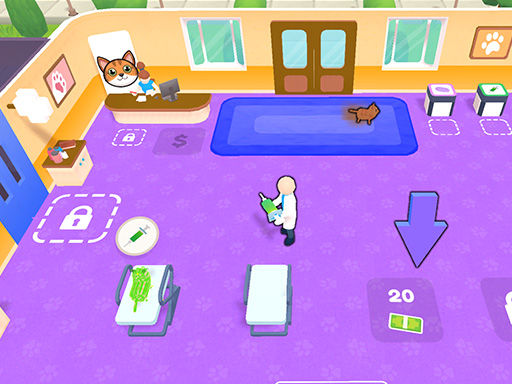
Pet Doctor Business Tycoon-Pet care game has the same structure with a different skin: you move with WASD or the arrow keys between patients, diagnose, clean wounds, check heartbeats, and perform surgeries across levels of sick, injured, or pregnant animals. The service time per patient is your cycle, and the walk between them is pure overhead. Players who treat it as a movement-optimisation game clear levels noticeably faster than players who treat it as a clicking game.
The check that takes thirty seconds
Pick one cycle. Watch it start to finish. Write down which step had something waiting on it. Buy for that step, and only that step. Then watch another cycle — the bottleneck will have moved, and that is the sign you did it right.
More games with this shape sit in the clicker category and across the full game library.